
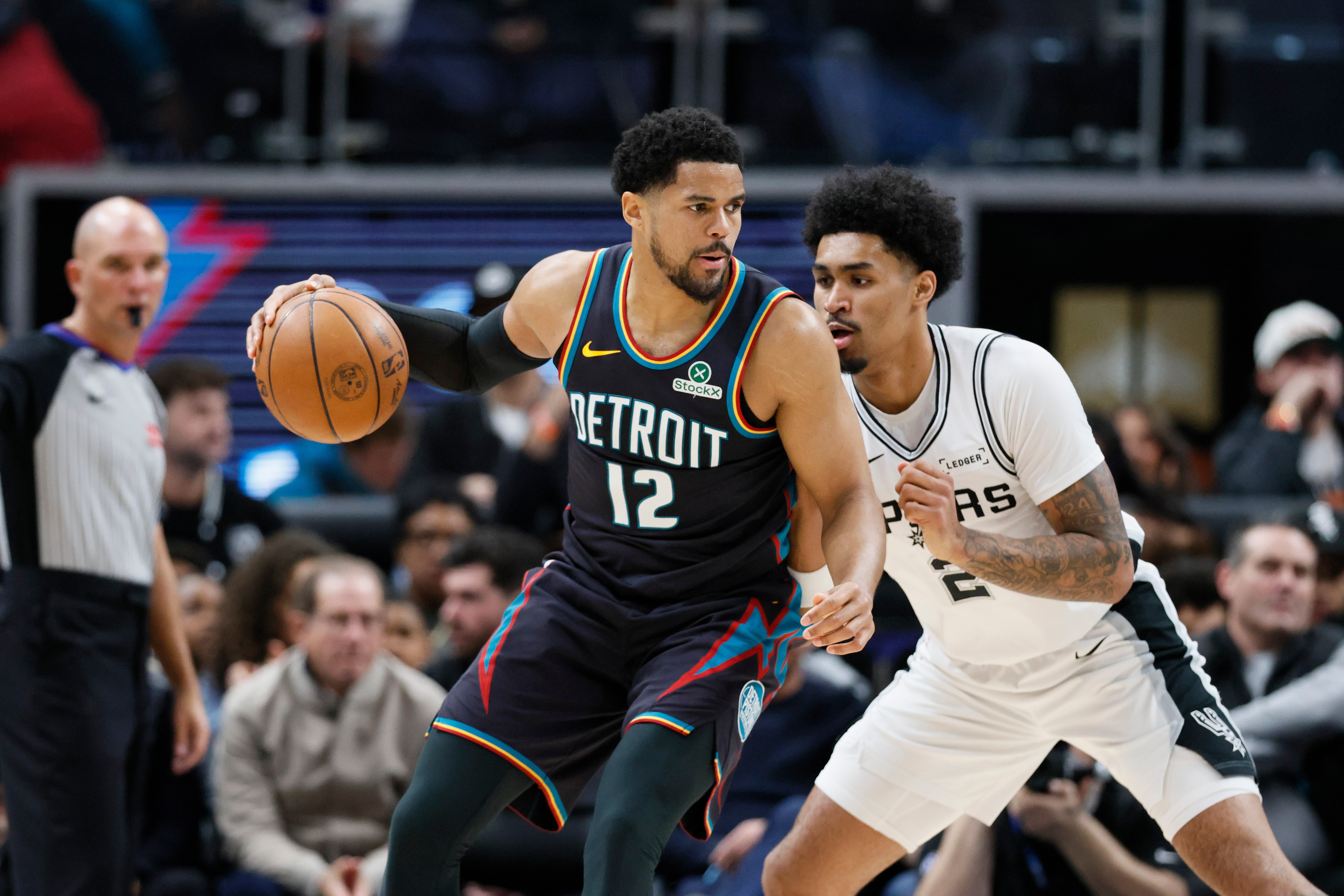
After losing the NBA Finals to the New York Knicks, the San Antonio Spurs got to work. They drafted Jayden Quaintance 20th overall, then traded up into the first round to nab Tarris Reed Jr. 26th overall.
After getting dominated by OG Anunoby in the Finals, it was clear that the Spurs needed to shore up the frontcourt. Both Reed and Quaintance will help, but neither of them is expected to be a high-level NBA contributor, at least not right away.
The Spurs were linked to many free agents. LeBron James, John Collins, Dean Wade, Rui Hachimura, Sandro Mamukelashvili, and Tobias Harris all fit the bill. On top of that, trade targets like Jaylen Brown, Kawhi Leonard, and Aaron Gordon were all floated, as well.
As things stand, the Spurs made three signings, bringing in Harris from the Detroit Pistons. As things stand, this is how the moves shook out.
Re-Signing Julian Champagnie: A-
Heading into the summer, the Spurs had two priorities: ink Victor Wembanyama to a long-term extension and keep Julian Champagnie under control.
Last season, Champagnie continued to break out, first playing his way into the starting lineup and then breaking the franchise record for most 3-pointers in a single season. Adding him was a must.
So why does he only get an A-? Simple: the Spurs need to save money for the future. Stephon Castle and Dylan Harper won’t be on their rookie deals forever, and the Spurs could have frontloaded Champagnie’s new contract even more than they did.
From 2026 to 2029, there’s only a $700,000 drop in salary. That could have been larger, and the Spurs lose a little bit of flexibility because of it.
Re-Signing Harrison Barnes: A+
One year, $8 million for Harrison Barnes. It’s hard to find a career 38.5 percent 3-point shooter for less than that, especially one with a championship pedigree.
It’s true, Barnes is no longer the player he once was, and he lost the starting role to Champagnie midway through last season. However, he’s a steady veteran. A key perk: he already knows their system.
Even the most composed veterans usually take some time to adjust to a new system. Barnes has been in San Antonio for two years, is close with Victor Wembanyama and De’Aaron Fox, and can play very substantial minutes as a starter or reserve.
Is he the best player in the world? No! But he brings everything one can reasonably expect for $8 million, and it’s only a one-year commitment.
Signing Tobias Harris: C+
Champagnie will make $15 million per season for the next three years. Tobias Harris will make the exact same, but for only two years. Plus, their stats were nearly identical last season.
So why are we so much lower on Harris? Well, for starters, he’s 33 years old. That’s not ancient by any metric, but it’s not a guarantee that he can sustain his play for another season, let alone two.
Plus, the Spurs needed a forward who could shoot and rebound. Harris does both of those things rather well. But so do James, Collins, Wade, and Mamukelashvili. San Antonio could have (should have!) gotten one of them, instead. Or they could have made a bid for Hachimura, who remains unsigned.
This isn’t to put down Harris; he’s adequate for the money and addresses a key area of need. The Spurs could have simply found a better player for roughly the same price.


Leave a Reply